

Choosing to end a marriage can feel overwhelming. For many families in Wyckoff, the divorce process raises questions about the future, financial stability, and how decisions will affect children. Divorce can look different depending on whether spouses can agree on the key issues or if disagreements require court involvement. Understanding how contested divorce and uncontested divorce work in New Jersey can help you determine the approach that best protects your rights and goals while reducing uncertainty during a difficult time.
A divorce is considered uncontested when both spouses agree on every major decision, including property division, parenting time, child custody, child support, and any spousal support. When spouses reach a full agreement before filing, they can present their settlement to the court for review and final approval without the need for a trial.
A contested divorce occurs when spouses disagree on one or more critical issues. In those situations, the court may need to resolve disputes, gather evidence, hold hearings, and issue a final judgment. This process generally takes longer and may involve more legal costs. Both types of divorce are valid options; the best one depends on your circumstances and whether cooperation is possible.
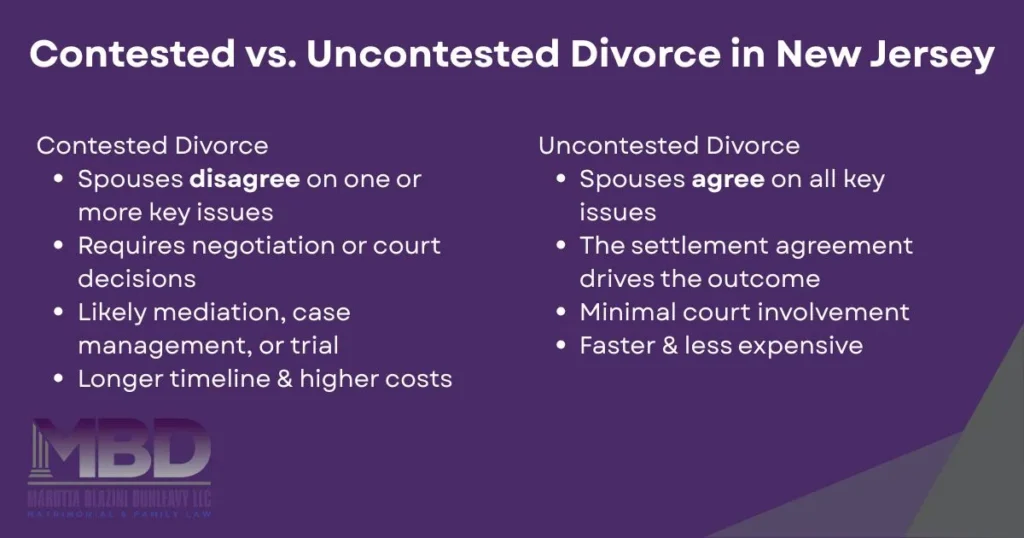
Uncontested divorces are typically finalized more quickly because there is no need for extensive litigation. Once the settlement agreement is completed and submitted along with required financial disclosures, the court can move efficiently toward a final judgment.
Another advantage is that uncontested divorces allow spouses to make decisions privately instead of leaving outcomes up to a judge. This keeps sensitive matters out of court and often reduces emotional stress for the entire family. It also allows both parties to feel more in control of the process instead of reacting to what a judge believes is best.
New Jersey generally requires that at least one spouse has lived in the state for at least one year before filing for divorce unless the case is based on adultery. Most divorces are filed under “irreconcilable differences,” meaning the marriage has broken down for at least six months with no reasonable possibility of reconciliation. This no-fault option allows spouses to proceed without placing blame and often simplifies the process.
To finalize any divorce — contested or uncontested — New Jersey requires complete financial disclosure, including assets, debts, income, and expenses. This ensures transparency and fairness and protects both spouses from inequitable agreements.
Even when both spouses agree, certain legal documents must be filed correctly to proceed. The spouse who initiates the divorce files a Complaint for Divorce. The responding spouse signs paperwork confirming they do not contest the divorce and agree to proceed without litigation. A marital settlement agreement outlining all terms of the divorce is then presented to the court. After review to ensure fairness and compliance with state law — especially in matters involving children — the court can grant a Final Judgment of Divorce. Because the agreement is mutual, court appearances are often limited or not required at all.
If agreement cannot be reached, contested divorce ensures that concerns are addressed through the court. The process begins with filing and responding to the Complaint, followed by a period of discovery where financial information and other evidence are exchanged.
Hearings, negotiations, mediation, and settlement conferences may occur in an attempt to resolve disputed issues. If disputes remain unresolved, a trial may be necessary. During the trial, a New Jersey judge reviews the evidence and makes decisions on matters including custody arrangements, support, and equitable division of marital assets.
This process takes longer and may be more demanding for everyone involved, but it exists to ensure a fair and lawful resolution when cooperation is impossible.
If spouses can communicate respectfully and are committed to full transparency, an uncontested divorce is usually the smoother path. It saves time and expense, preserves privacy, and helps reduce conflict, something especially helpful for families with children.
However, contested divorce is sometimes necessary to protect parental rights, financial security, or personal safety. When disagreements involve complex assets, business ownership, hidden finances, or serious conflict over parenting time, court involvement helps ensure decisions are made with fairness and the best interests of children in mind. Having the right legal guidance early can make a significant difference in how negotiations unfold.
The timeline depends on whether the case is contested. Some uncontested divorces may be finalized in a matter of months, provided the paperwork is complete, and both spouses cooperate throughout the process.
Contested cases can take significantly longer, often many months to over a year, because more court steps are required. Spouses in Wyckoff benefit from starting early with legal guidance so that the process moves forward efficiently wherever possible.
Yes. Sometimes spouses believe they are in agreement, but disagreements emerge during negotiations. In such cases, the process may shift into contested proceedings. The opposite can also occur: A contested divorce may settle before trial once spouses reach an agreement.
Having legal support from the beginning helps avoid overlooked issues and unnecessary delays, while ensuring your rights are protected regardless of how the case progresses.
Every divorce is different. Whether you and your spouse agree on most issues or anticipate disputes that require court involvement, the Wyckoff divorce lawyers at Marotta Blazini Dunleavy LLC can help you understand your options under New Jersey law and guide you through each required step. With the right support, you can move forward confidently and secure a fair outcome for your future. You can schedule a initial consultation with a divorce attorney by using our online form or by calling us today at 201-368-7713. With our offices located in Maywood, New Jersey, we proudly serve clients throughout the surrounding areas.
OUR PRACTICE AREAS
CONTACT OUR FIRM
To schedule a consultation with one of our attorneys, fill out the form below!