

Divorce is rarely simple, but when substantial wealth, business interests, executive compensation, and valuable real estate are involved, the stakes become significantly higher. In Paramus, New Jersey, high-asset divorce cases often involve complex financial portfolios, closely held businesses, investment accounts, retirement assets, and high-value personal property. Bergen County families with significant assets must navigate New Jersey’s equitable distribution laws while protecting financial stability, privacy, and long-term goals.
New Jersey courts do not automatically divide marital property equally. Instead, they apply equitable distribution principles, meaning assets are divided fairly based on statutory factors. In high-asset divorce matters, identifying, valuing, and allocating property can become one of the most contested aspects of the proceedings. A detailed understanding of how New Jersey law applies in Paramus and throughout Bergen County is critical when your financial future is at stake.
A high-asset divorce generally involves substantial marital property, complex holdings, or both. This may include multiple residences, investment properties, business ownership interests, stock options, restricted stock units, deferred compensation, retirement accounts, trusts, and luxury personal assets.
In Paramus, where home values and household incomes frequently exceed state averages, high-asset divorce cases often include significant real estate equity and executive-level income structures. When one or both spouses own a closely held business or professional practice, valuation becomes central to the case. Courts must determine which assets are marital and subject to distribution, and which are separate property under New Jersey law.
New Jersey follows an equitable distribution model. This does not necessarily mean a 50-50 split. Instead, judges consider factors such as the length of the marriage, each spouse’s income and earning capacity, contributions to the marriage, and the standard of living established during the marriage.
In high-asset divorce cases, equitable distribution may require forensic accounting to trace commingled funds, analyze business records, and determine whether certain assets appreciated during the marriage. Appreciation of separate property may become marital if both spouses contributed to its growth. Courts also evaluate tax consequences, liquidity concerns, and future financial impact when distributing complex portfolios.
Because Paramus residents often hold diversified investment accounts and multiple properties, detailed financial documentation is essential to ensuring a fair and balanced outcome.
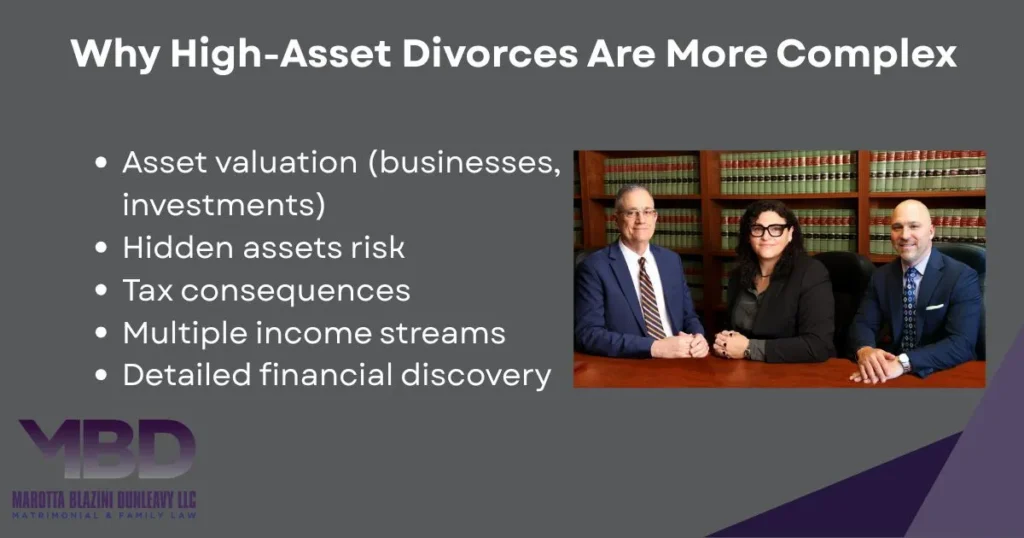
When a spouse owns a business or professional practice, valuation becomes one of the most significant issues in the divorce. Courts may review revenue history, projected earnings, liabilities, market comparisons, and goodwill. In Bergen County, where many professionals operate medical, legal, and financial practices, distinguishing enterprise goodwill from personal goodwill can affect the final valuation.
In many cases, one spouse retains ownership while the other receives offsetting assets or structured payments. Courts aim to preserve viable businesses while still achieving equitable distribution. Proper valuation ensures that neither spouse is unfairly advantaged or disadvantaged.
Alimony in New Jersey is determined by statutory factors, including the duration of the marriage, the standard of living during the marriage, each spouse’s earning capacity, and financial need. In high-asset divorce cases, the marital lifestyle may include private schooling, travel, substantial investments, and high discretionary spending.
Open durational alimony may apply in long-term marriages, whereas limited duration alimony may be appropriate in shorter unions. Courts focus on maintaining a reasonably comparable lifestyle when possible, while also considering each spouse’s ability to achieve financial independence. In high-income households, precise financial disclosures are critical to evaluating appropriate support levels.
High-asset marriages often involve prenuptial or postnuptial agreements. In New Jersey, these agreements are generally enforceable if there was full financial disclosure and the agreement was entered voluntarily.
In Paramus high-asset divorce matters, a valid agreement may significantly limit disputes over asset division or alimony. However, courts will review agreements carefully to ensure compliance with legal requirements and fairness under the circumstances.
Privacy concerns are common in high-asset divorce proceedings. Financial disclosures may include business records, tax returns, and detailed personal information. Although New Jersey court proceedings are generally public, certain financial documents may be protected through procedural safeguards.
Paramus residents with prominent careers or significant community visibility often seek to minimize unnecessary public exposure. Thoughtful case management and negotiation strategies can help protect sensitive financial information while complying with court requirements.
Statewide data show that thousands of divorces are filed annually in New Jersey, with Bergen County consistently reporting a significant share due to its population size and economic profile. Financial disputes remain one of the leading causes of prolonged divorce litigation.
In high-asset cases, disputes frequently arise over business valuation, executive compensation structures, investment portfolios, and real estate equity. These matters often require extensive financial discovery, which can extend timelines compared with standard divorce proceedings.
Early preparation can significantly impact the outcome of a high-asset divorce. Gathering tax returns, account statements, property deeds, business documents, and estate planning materials ensures transparency and readiness.
Spouses in Paramus should also consider tax implications, liquidity concerns, and long-term retirement planning. Strategic planning may address estate consequences, investment restructuring, and future earning capacity. Careful financial organization from the outset helps prevent costly oversights and strengthens negotiating positions.
The Paramus high-asset divorce lawyers at Marotta Blazini Dunleavy LLC understand the financial and legal complexities that substantial asset cases present under New Jersey law. When your property, income, and long-term stability are involved, experienced guidance can help you navigate Bergen County divorce proceedings with clarity, preparation, and a focus on protecting your future. For a consultation, contact us using our online form or call us today at 201-368-7713. Located in Maywood, New Jersey, we proudly serve clients throughout the surrounding areas.
OUR PRACTICE AREAS
CONTACT OUR FIRM
To schedule a consultation with one of our attorneys, fill out the form below!